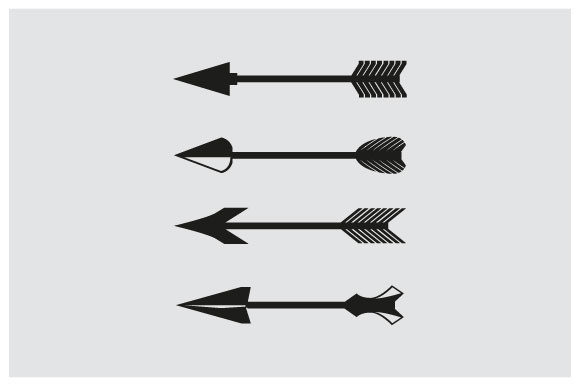
Decorative Arrows SVG
A Hand-Drawn Touch That Feels Like a Signature, Not a Stamp
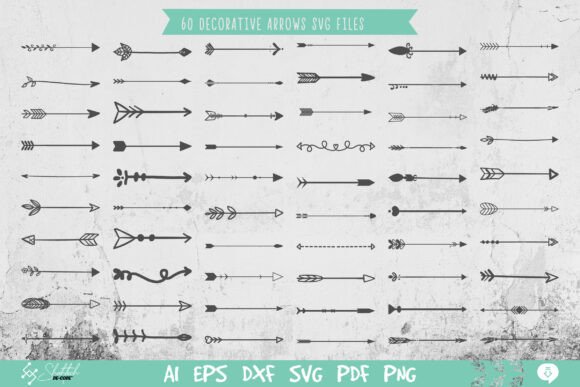
When I opened the Decorative Arrows SVG bundle for the first time—prepping for a client’s custom embroidered tote bag—I didn’t see “graphics.” I saw rhythm. The arrows aren’t rigid or technical; they’re fluid, slightly imperfect, and full of quiet intention—like something sketched during a quiet morning coffee rather than generated by algorithm. There’s a gentle asymmetry in the tribal borders, soft vine curls that taper naturally, and tiny hearts nestled where stems meet leaves. This isn’t clip art. It’s illustration with breath—and that matters deeply when you’re translating it into thread.
Where It Lives Best: Embroidery Projects That Invite a Second Look
I tested three motifs from the Decorative Arrows SVG set on organic cotton tea towels, baby onesies, and unstructured linen aprons—all staples in my small shop. On the towel, a curved arrow border wrapped neatly around the hem: the vines stitched cleanly, the feather details held up surprisingly well at 3.5" wide, and the overall effect was warm, artisanal, and quietly confident. On the onesie? A single heart-tipped arrow centered over the chest read as sweet but not saccharine—ideal for gender-neutral nursery decor or holiday embroidery. And on the apron? A narrow divider motif ran vertically along the pocket seam—subtle enough to feel intentional, not busy.
These work especially well as embroidered patches, tote bag designs, and sweatshirt embroidery accents—places where customers pause, touch, and connect with texture. They elevate personalized gifts because they carry personality without shouting. For Etsy sellers and craft business owners, that nuance builds trust: it signals care in curation, not just convenience.
Real Fabric Realities: Where Caution Keeps Your Stitching Sincere
Let’s be direct: not every piece in this Illustrations bundle translates equally well across all embroidery project contexts. The most delicate feather-and-vine corners? Lovely in vector—but under dense fill stitch on thin jersey, they can blur or pucker. I learned that testing the Decorative Arrows SVG on scrap fabric wasn’t optional—it was essential. On stretchy fabrics like lightweight knits, I added tear-away + cut-away stabilizer combo and reduced stitch density slightly. On dark fabric, I swapped standard 40-weight thread for matte-finish rayon to keep the hand-drawn softness visible—not glossy or flat.
For caps and curved surfaces, I avoided the widest border motifs (over 4") and stuck to single-line arrows or compact heart-and-arrow combos. Tiny lettering isn’t included here—and that’s fine. This set shines as design assets for visual punctuation, not typography. And while it’s lovely on kitchen towels or pillow covers, I’d skip it for high-wash items like baby bibs unless the design is simplified first—fine line work can soften after repeated laundering.
What Makes It Feel “Handmade” (Without Looking Unfinished)
The charm of Decorative Arrows SVG lies in its controlled looseness. The arrows don’t snap to perfect angles. The leaves vary subtly in size. That’s not inconsistency—it’s character. When stitched with a satin stitch outline and light fill, those variations read as human-made, not machine-perfect. That distinction elevates your finished product: customers don’t buy “an arrow,” they buy a detail that feels chosen, considered, and kind.
It also supports brand consistency for small shops. Whether you’re embroidering a wedding guest book cover or a boutique’s seasonal sweatshirt line, this set offers cohesion without repetition. Use one vine motif on packaging tape, another as an apron divider, and a third as a subtle tag accent—you’re building recognition, not redundancy.
Practical Notes Every Embroidery Designer Should Keep Handy
- Always test first: Run a sample on your exact fabric + stabilizer combo—even if it’s “just a line drawing.” Thread tension shifts everything.
- Check contrast early: View your digital embroidery file in black-and-white mockups. Does the arrow weight hold up on both light and dark backgrounds?
- Hoop size matters: Some border motifs span 5–6"—verify your machine’s max hoop before digitizing or purchasing.
- Inspect small details: Zoom in on feather tips and leaf veins in your embroidery software. If vectors are overly complex, simplify before stitching—especially for applique design prep.
- Licensing clarity: Since this is a Graphics bundle marketed for commercial use, confirm whether resale of finished embroidered goods is permitted—and whether digital redistribution (e.g., as part of a craft kit) is allowed.
- Fabric texture is a partner, not a barrier: On nubby linen or terry cloth, lean into bolder arrow forms and avoid ultra-thin connecting lines. Let the material speak alongside the design.
Not Just Decoration—A Quiet Design Decision With Ripple Effects
I recently used a simplified version of the leaf-and-arrow motif on a set of holiday embroidery kits for local makers. Feedback was telling: customers didn’t say “the arrow is pretty”—they said, “it feels like it belongs there,” “I could imagine this on my grandmother’s quilt,” “it doesn’t look mass-produced.” That’s the power of thoughtful machine embroidery design. The Decorative Arrows SVG set doesn’t dominate a project—it completes it. It works because it respects the object it’s on: a tea towel’s utility, a baby onesie’s tenderness, a tote bag’s daily rhythm.
For creative entrepreneurs, that’s gold. It means less time editing, more time making—and more confidence offering something that feels both distinctive and sincere. You’re not just adding decoration. You’re adding resonance.